Pages

Thursday, April 30, 2026

Post-Conceptual Composition


Conceptual composition may or may not be played out. Certainly the works that have come to define it have created a recognizable framework for critical appreciation and as I see many much younger composers taking up its approaches in what feels like a formulaic way, that seems to signal a phase of exhaustion to me, but perhaps not to others.
What I am addressing are the ways conceptual composition is the indicative aesthetic in our time—for reasons that have to do with larger cultural shifts.
Not everyone will remember the resistance to conceptualism’s place in music history, but in the 1990s, it was in response to the prevalent notion that minimalism had been the single most important development of the 1960s.


What composition and aesthetics are, and how we understand them, is not unrelated to what they do, or how they show and indicate other changes.  I sense emergent phenomena in the current culture that are expressions of a collective voice, at a scale, and with a willing participation in group think that is different from that which characterized modernism, romanticism, and contemporary work.
Will it displace other modes? Take its place alongside? Change values and aesthetic practices?

Questions as yet unanswerable.

Secret Revolutions: The Living Brevity of "Locked Transit" for Flute and Bassoon.


"Locked Transit" for Flute and Bassoon.  

Published by LNM Editions

(Laboratorie New Music)

In experimental chamber music, moments of brevity often conceal intricate worlds of inner complexity.  Such is the case with Locked Transit for Flute and Bassoon.  This work compresses an extraordinary density of action, transformation, and narrative into just 67 seconds of performance time.

From the first bar, Locked Transit thrusts its performers and its listeners into a whirling, pulsing space.  It is a sonic environment that is not merely activated by gesture but is itself the byproduct of a living, breathing musical metabolism. The flute and bassoon do not present melodies or even traditional textures; rather, they coax sonic phenomena into existence, layering micro-gestures, fluttered articulations, tremulant dynamics, and frantic registral leaps that seem less like performance and more like the exposing of some hidden biological process.

What makes the piece novel is that it does not wait for a climax or a completed "event" to unveil its intricacies. Instead, the score is designed to allow every notational gesture, even in its early, unstable forms, to reveal its secret transformations. Every slur, every trill, every dynamic fidget shows its own evolution before it even stabilizes into anything like a recognizable figure. The music lives in a constant state of pre-fulfillment, a paradoxical space where ideas are both forming and dissolving at once.

This act of allowing musical material to "betray" its own nature draws a conceptual through-line back to philosophies of non-inert matter, of the animate hidden within the inanimate. Locked Transit is less a "work" in the conventional sense and more a temporary biosphere of sound: teeming, unstable, yet intensely organized.

The score’s extreme complexity is never gratuitous. Instead, every hyper-specific marking; the tight layering of alternate fingerings, the insistence on minute inflections of dynamic shape,  serves to focus the listener’s perception inward, toward a sense of material caught in the act of becoming. The performers, too, are asked not to "build toward" a musical climax but to inhabit the tiny internal whorls of each gesture, trusting that the larger structure will emerge not from grand arcs, but from the coalescence of micro-movements.

In the end, Locked Transit is not about "arrival." It is about the impossibility of stasis, the refusal of sonic material to be frozen or defined. Even within 67 seconds, it makes clear that sound itself is never at rest.  It is always moving, shedding, reforming...a secret morphology made momentarily audible.


On Neologisms as Notation


One of the recurring elements in my scores is the use of neologisms, invented words that do not arrive with a pre-approved performance recipe already attached to them.

A term like allegro or presto is useful because it is efficient. It carries centuries of shared instruction. But that efficiency can also become automatic. The performer sees the word and reaches immediately for a known behavior. I am often interested in interrupting that reflex.

A neologism does something different. It borrows from the atmosphere of language without collapsing into fixed meaning. It feels adjacent to something legible, but not fully owned by convention. In that gap, interpretation becomes active again. The performer has to ask: is this a speed, a pressure, a color, a texture, a behavioral state, a spatial condition, a dosage, a distortion?

That uncertainty is not there to be obscure. It is there to produce thought.

In works like the attached image, a word such as PLIMPELOMIE does not function as decorative nonsense. It acts as a notational device. It pulls from our broader lexicon of association, sound, rhythm, branding, medicine, and invented speech, then asks the performer to construct meaning from inside the work rather than retrieve it from a standard glossary.

For me, this is one way notation can remain alive. Not by rejecting language, but by forcing language to become unstable enough to think again. A neologism reopens the score. It makes the performer do more than decode. It makes them interpret.

Wednesday, April 29, 2026

Unpacking "Sequenze for Solo Flute."

Page 33 from Sequenza for Flute Score


Unpacking the Dense Informational Layers Within "Sequenze"


At first glimpse, the intense visual notational archetype engulfing the score to "Sequenze" for solo flute seem to drown any semblance of tradition in a wave of radical experimentation. Yet suspended across its stylistic riptides lies an unmistakable instrumental identity still wrestling with its own lineage amidst efforts to channel the zeitgeist.


Within the turbulent symbology, echoes of the classical past commingle freely with cryptic visions of sonic futures, juxtaposed but not opposed.


Much like the technology-warped dreamscapes of J.G. Ballard, this score leverages deliberately ambiguous imagery allowing the familiar and alien to be spoken in the same visual language.


Geometric notation weaves seamlessly into fluid contours before dissolving into impressionistic textures reminiscent of Monet. Throughout, an oneiric fluidity destabilizes perception - are we moving across this landscape, or is the terrain warping around us as in visions barred from waking minds?


Adding to this disorienting dynamism, concepts of scale and velocity dissolve into relativity. Musical figures contract and bloom to fractal dimensions, first presenting as localized components before reappearing reconstituted on the global structural scale. Passages demand blistering physical feats before suddenly snapping into slow motion hypnagogic drift.


Yet for all its postmodern pastiche and casual subjunctive explorations, an appreciation for heritage peers through the turbulence. There is joy and wonder in superimposition, not rejection alone. In harmonizing forward dreams with backward glances, it locates universality

within radical diversity.


This novel notation liberates rather than limits referent tradition now unbound by responsibility to static convention. Inside ostensible chaotic abandon lies meticulous celebrating iconoclasm and reverence alike.


In this reconciliation of contradiction and multidirectional temporal dialogue, "Sequenze" finds resonance between past glory and present possibility without demanding sacrifice of either. Through ever-shifting imagery unfastened from rigid representation yet secured to subjective intention, the score captures potent "truth" too nebulous to be spoken except through the vibrant turbulence of augmented imagination.


Tuesday, April 28, 2026

"Tourbillon Beneath" For Piano


Primary Score


"Tourbillon Beneath". For Piano: Primary Score and Transparency Atelier


With Performance Guidance - "Commedia Meteorologica."  A Weather Log to be read by the performer privately prior to the performance of the work.

PDF File to Performance Guidance:

https://drive.google.com/file/d/1ygP_iZFXuWXz-ik5UYZoXbISc349uVzg/view?usp=sharing


Transparency Atelier


New Work: The Dynamic Spatialist Score

Paolo Scheggi's "Intersuperficie curva bianca"


With inspiration from Paolo Scheggi and Enrico Castellani, I began this commission for solo cello with the intent of pushing the boundaries of traditional notation into new dimensions.


I wanted to embrace investigations into the relationship between the surface and depth of the visual field and how it shapes the Cellist’s musical lexicon. In the physical score, I am introducing three monochromatic surfaces each perforated with biomorphic or geometric openings and layered one on top of the other.  Each surface plane measures 32” X 16”. 


The templates that follow represent the layers with the red outline being the bottom layer, the blue  being the middle layer and the black being the top layer.  The three layers are bound together with epoxy and represent a set.


The wide border surrounding the grid of apertures acts as a visual pause, giving the work a notable balance between the dynamism of the openings and the stillness of the balance of the layer.


Executed in a monochromatic white, I seek to present a combination of balance, tension and materiality.


This is simply the initial foundation for the work.  There will be further elements I will introduce as the work progresses.


Top Layer Die Cut Template


Middle Layer Die Cut Template


Bottom Layer Die Cut Template


"Behind A Dark Curtain Inside A Dented Van" for Contraforte (Eppelsheim)

"Behind A Dark Curtain Inside A Dented Van"  

for Contraforte (Eppelsheim)

Bil Smith Composer

2022

Published by LNM Editions

Link to Hi-Res PDF Score


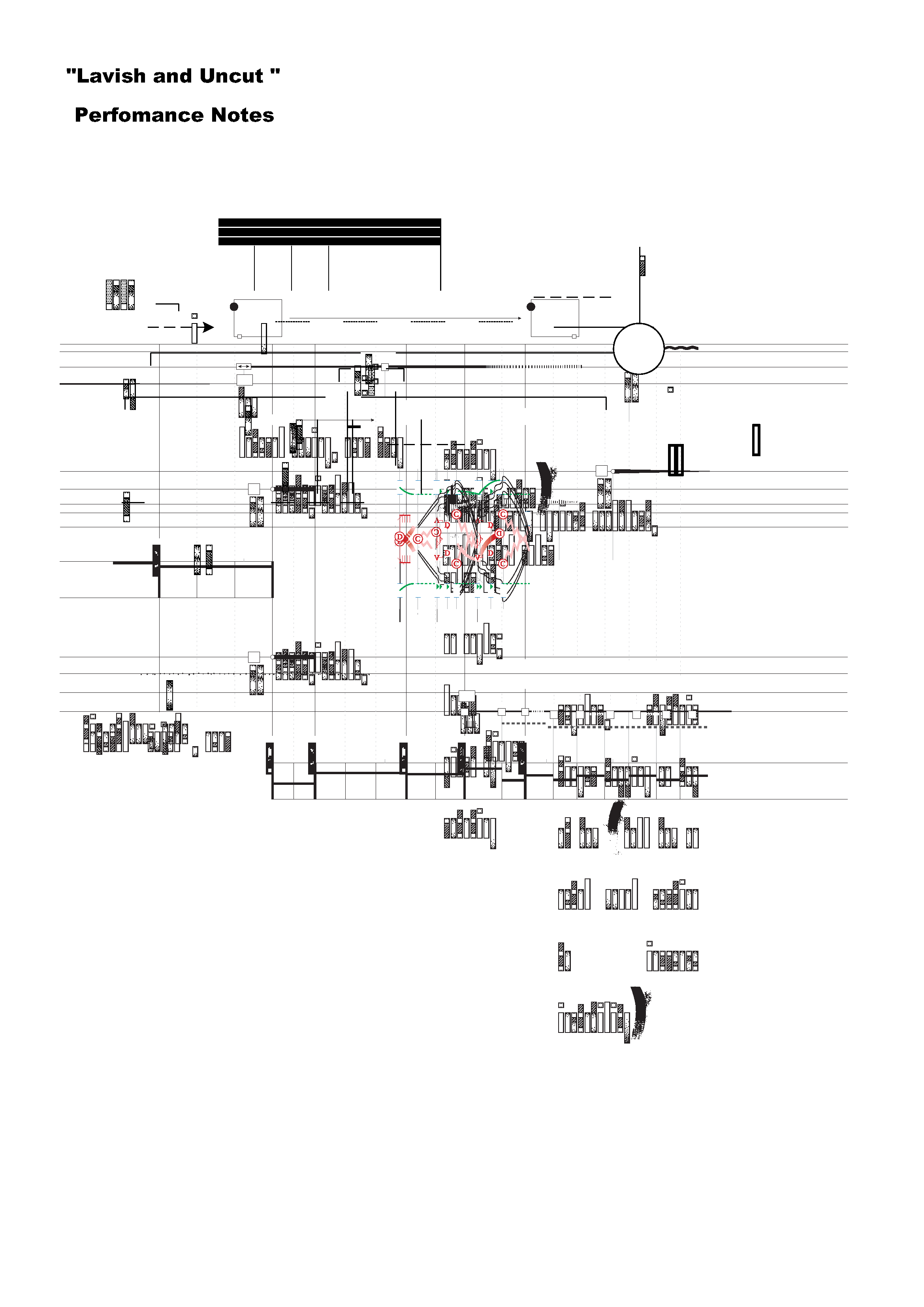
"Lavish And Uncut" For Trombone (PDF Score Link)


"Lavish And Uncut"

For Trombone

Bil Smith Composer

2022

Published by LNM Editions

Link to Hi-Res PDF (32 pages)

https://drive.google.com/file/d/1qHQf4dih6eUm5_PBtE18wod4ru1Wv0UP/view?usp=sharing


Saturday, April 25, 2026

"The Criminality On The Staircase" For Solo Tuba. Bil Smith Composer


"The Criminality On The Staircase"  

For Solo Tuba.  

Bil Smith Composer

Published by LNM Editions

Link To Full Score (PDF)

(Note; When downloading, be patient as this is a large file)


My score for "The Criminality On The Staircase" for Solo Tuba presents an example of a multimodal, maximalist compositional lexicon which is underpinned by a notational ontology that navigates the complex interplay between geometric forms and musical interpretation. It mirrors a continuum that extends from the concrete to the abstract, from the geometrically symmetric to the asymmetric, and onwards to the intricacies of knotted and woven morphologies.


The notational system employed here is as revolutionary as it is ancient, drawing inspiration from the mathematical explorations of Archimedes who, in his pursuit of pi, utilized recursively truncated polygons to approximate the circle's curvature. Similarly, the score's notational framework employs a number code based on the traversal of vertices in polygonal shapes whether they be they convex or non-convex, symmetric or asymmetric. 


This traversal can occur in a clockwise or anti-clockwise direction, initiating a cycle of numbers that not only defines the shape in question but also allows for the transformation of one polygon into another through the manipulation of this code. Such a system underscores a philosophical and aesthetic inquiry into the nature of form and transformation, suggesting a fluid continuum between different states of symmetry and asymmetry, convexity and non-convexity, and extending this exploration to the realm of knotted and woven structures.


The number code, an arcane lexicon that allows for the manipulation from one polygonal shape to another, is not just notation but a narrative in itself. It tells of transformations, of the shifting landscapes of musical geometry where polygons serve not merely as symbols but as the very building blocks of composition.


This code, a cipher of sorts, speaks to the adventurous, beckoning them to alter the course of musical currents with the mere adjustment of sequences, a power that blurs the lines between composer and alchemist.


Within this esoteric framework, Pentiles (a concept borrowed from the architectural domain) finds new life on curved hypersurfaces and hyperstructures, suggesting applications far beyond the scope of mere notational elements.


Yet, what of the tuba, you might ask? This humble instrument, often relegated to the background, becomes in "The Criminality On The Staircase" the vessel for this grand experiment. It is through its brass voice that the complex interplay of geometry and sound is manifested