Monday, March 16, 2026

"Loy's Labyrinth" for Vibraphone and Harp

"Loy's Labyrinth" 

for Vibraphone and Harp

Bil Smith Composer


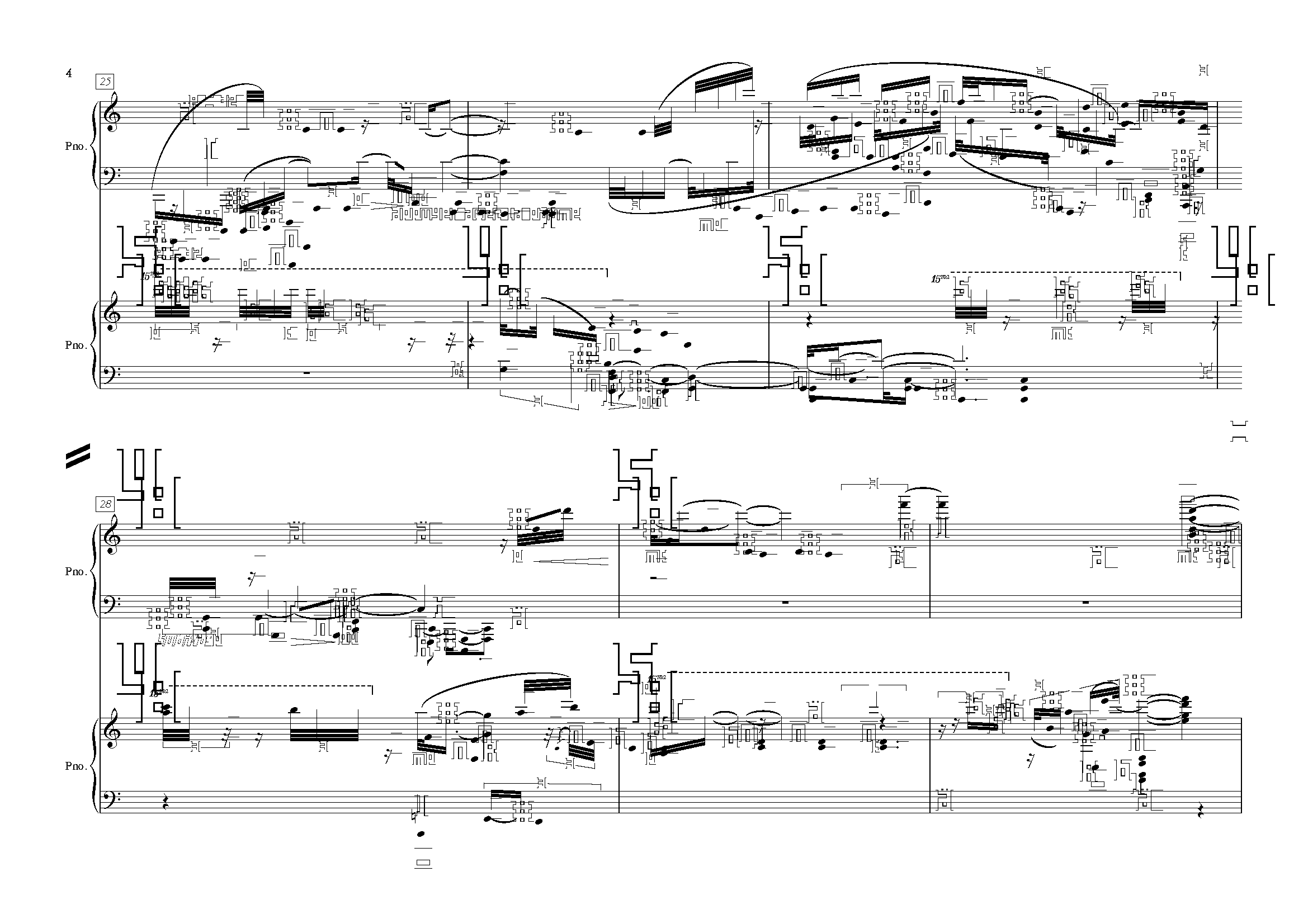
"Loy's Labyrinth" is not a composition that provides a comfortable center for its performers. Much like Loy's writings, it resists the confines of a fixed point and urges us to move forward, accepting the fluidity of "there" while rejecting the constraints of "here."


Mina Loy, known for her undulating idiosyncratic script and avant-garde literary works, serves as the muse for this composition. Her writings, characterized by their systematic organization into gridded size tableaux and "day calculations," disrupted ocular-centric regimes of viewing. Similarly, "Loy's Labyrinth" carries forward this spirit of defiance, activating the potential for embodied experience through its musical expression.


Much like Mina Loy's own engagement with profit, commodification, multinationalism, location, politics, and creative labor, "Loy's Labyrinth" is part of a "convoluted distributive process." It refuses to be confined within traditional musical boundaries and instead navigates the complex terrain of cultural and creative exchange. This composition's notational system becomes a tool for generating optic tethering, connecting it with the broader context of contemporary artistic discourse


The score is firmly grounded in the inescapable materiality of the world. This materiality anchors it in the tangible realm, allowing it to interact with and be influenced by every other cultural manifestation it encounters. It thrives on contamination, drawing inspiration from various sources and transcending traditional musical constraints.


Mina Loy, born Mina Gertrude Löwy on December 27, 1882, was a remarkable and influential figure in the realms of literature, art, and feminism during the early 20th century. Her life and work were characterized by a relentless pursuit of intellectual and creative freedom, challenging societal norms, and pushing boundaries in both her writing and her activism.


Loy, though often overlooked in canonical narratives of modernism, was undeniably a vital poet and artist who played an instrumental role in numerous avant-garde movements, including Futurism, Dada, and Surrealism. Her life and work were marked by a relentless pursuit of artistic innovation and a tireless commitment to pushing the boundaries of conventional art and literature. Let's delve deeper into the life and contributions of this remarkable transatlantic modernist.


In the early decades of the 20th century, Loy embarked on extensive travels across Europe. She immersed herself in the vibrant cultural scenes of London and Paris, where she rubbed shoulders with emerging modernist writers and artists. Notable among her acquaintances were luminaries like Gertrude Stein and Pablo Picasso.


Loy's European journey led her to Florence, Italy, where she became closely associated with the Italian Futurists. During her time in Florence, she engaged in romantic relationships with prominent artists of the movement, including F. T. Marinetti and Giovanni Papini. Her participation in Futurism marked her early immersion in the avant-garde.


The outbreak of World War I forced Loy to flee to the other side of the Atlantic. She found herself in New York, where she became an integral part of the American and expatriate artistic and literary circles. Loy contributed to influential publications like Camera Work and Rogue, solidifying her position as a figure of importance in the New York avant-garde scene.


In 1917, Loy collaborated with the renowned artist Marcel Duchamp to co-publish The Blind Man, a two-issue Dadaist periodical. This collaboration exemplified her commitment to the Dada movement, which challenged conventional notions of art and aesthetics. Loy was instrumental in disseminating Dadaist art and ideas to American audiences.


In 1918, Loy married Arthur Cravan, an amateur boxer and Dada poet, in Mexico City. Cravan's disappearance at sea two years later marked a tragic episode in Loy's life. She dedicated significant time and effort to searching for him, but he was never found.


Mina Loy's life and career were characterized by a commitment to artistic experimentation and a willingness to challenge established norms. Her involvement in multiple avant-garde movements and her pioneering contributions to modernist literature make her a figure of enduring significance in the history of art and literature.


Despite being overshadowed by some of her contemporaries, Mina Loy's legacy continues to inspire contemporary artists and writers who appreciate her unyielding dedication to innovation and her fearless exploration of the avant-garde.


"Cartoon Lucination Imposes Claims" for Harp and Celeste. PDF Link To Full Score.


"Cartoon Lucination Imposes Claims" 

For Harp and Celeste

Bil Smith Composer

Commissioned by Alps Electronics

PDF Score:


"Red Is You And You"
 for Piccolo (Soprillo) Saxophone


"Red Is You And You"

for Piccolo (Soprillo) Saxophone

Bil Smith Composer

Score Published by LNM Editions

About The Soprillo:

The Soprillo Saxophone is a piccolo saxophone. It is technically known as the sopranissimo saxophone. Currently, it is only manufactured by one company: Benedikt Eppelsheim Wind Instruments in Germany.

In the saxophone family, it is considered to be the highest and smallest, sitting just above the sopranino.
It is pitched in Bb, and is one octave above the soprano saxophone. Its written range is Bb3 to Eb6, or concert pitches Ab4 to Db7. It is not considered a standard instrument for jazz or orchestral groups.

One unique quality of the soprillo, as opposed to the more common soprano saxophone, is the placement of the octave key. On a soprillo sax, the octave is actually part of the mouthpiece! This is unusual to see in practice, but makes sense acoustically.

As the soprillo is only thirteen inches long with the mouthpiece attached, the tone holes are extremely close together. Therefore, the octave key would need to be placed much closer to the source of the sound – the vibrating - rred than on other saxophones. Because the keys are so small, the pearl buttons almost completely cover the keys and tone holes. This is a very small saxophone for most players. Playing the soprillo requires exceptional strength. Because the embouchure needed is very firm and the range is exceptionally high, it is only recommended for professional players.

“Enclave of the Curated Pursuit” for Viola, Vibraphone and Flugelhorn

"Enclave of the Curated Pursuit"

for Viola, Vibraphone and Flugelhorn

Bil Smith Composer

2023-2024

Published by LNM Editions

20" X 10"

Link to Full Score PDF


Hypo-Neology in Compositional Practice: A Lexical Approach to Experimental Notation

In my compositional framework, hypo-neology (the creation of sub-words, proto-words, or semi-legible linguistic fragments) is not merely a poetic flourish, but a central ontological axis of the score itself. Where neology concerns the invention of entirely new words, hypo-neology engages the threshold of language, operating beneath standard meaning, at the level of gesture, impulse, and sonic residue. These lexical artifacts function less as symbols to be decoded and more as auditory fossils, embedded in the strata of the visual field.


Lexical Residue as Sonic Prompt

Hypo-neologisms in my scores exist in a pre-semantic or post-lexical state, partially eroded, over-inscribed, looped, or mirrored. They are not intended to communicate directly in linguistic terms. Instead, they perform as notation-objects, catalyzing sonic imagination in the performer.

Rather than specifying pitch, rhythm, or articulation in traditional ways, these word-forms ask:

What does this fragment feel like when sounded?
What vocal inflection does a crumpled word demand?
What gesture is required to complete an unfinished sentence?


The Score as Polylingual Palimpsest

Influenced by Hanne Darboven’s numerico-linguistic grids, Ed Ruscha’s textual austerity, and Tacita Dean’s archival poetics, my use of hypo-neology situates the score as a layered site; a part linguistic excavation, part speculative grammar. The performer is placed in the position of a semantic archaeologist, encountering linguistic fragments whose original context has been lost or deliberately withheld.

This aligns with the visual texture of my pages, which often include:

  • Typographic microstructures

  • Crossed-out neologisms

  • Echoic syllabic forms

  • Spatialized language arranged not for reading, but for listening with the eyes


Tactile Semantics and Performer Activation

The hypo-neologism acts as an activator.  It is a point of engagement for the performer’s interpretive imagination. Drawing influence from Cornelius Cardew’s graphic provocations and Alberto Burri’s ruptured surfaces, the fractured word in my notation becomes sonic material, sculpted not just by voice or instrument, but by touch, breath, and interpretive risk.

These elements are often designed to be:

  • Unreadable but pronounceable

  • Familiar yet untranslatable

  • Silent but resonant

This tension creates a field of ontological uncertainty where sound emerges not from instructions, but from lexical hauntings from what might have been a word, a name, a direction.


Hypo-Neology as Resistance to Semantic Closure

The hypo-neologic fragment resists the tyranny of closure. Unlike traditional notation, which fixes meaning into reproducible sound events, my use of text operates in the fugitive zone between language and noise, reading and voicing, image and utterance.

This is a deliberate political and aesthetic stance. Inspired by Enrico Castellani’s tension fields and Burri’s ruptures, I use hypo-neology to rupture the presumed transparency of the score. It is an anti-authoritarian act. A refusal of the fixed. A commitment to semantic entropy.


The Composer as Lexical Architect

In sum, hypo-neology in my compositional approach is not a side-effect of poetic excess. It becomes a structural tool, a performative condition, and a methodological commitment. The invented fragment is the score’s heartbeat: unstable, intimate, and unfinished.

It invites the performer not to obey, but to co-author, to listen to the page the way one listens to ruins, archives, or tongues never fully learned.

The hypo-neologic score does not say what it means.
It becomes what you hear when you try to make it say anything at all.

"A Miraculous Positional Memory". For Alto Clarinet and Baritone Horn. The Score


"A Miraculous Positional Memory"

For Alto Clarinet and Baritone Horn

Bil Smith Composer

The Full Score:


Saturday, March 14, 2026

Richter and Fluxus Inspired Score for Contrabass Clarinet


My solo contrabass clarinet score pulls ideas from Gerhard Richter’s “Strips” paintings and from Fluxus. It mixes visuals, chance, bits of traditional notation, and a hands-on performance setup. The point is to loosen the usual rules of composition and let the player build the piece in real time, almost the way you would assemble an artwork from parts.

Richter’s “Strips” as a working model

Richter made the “Strips” by slicing an abstract painting into horizontal bands and then rearranging them. The result still carries the DNA of the original painting, but it becomes something new through cutting, reordering, and digital processing.

That logic maps well to sound. In this score, musical ideas are broken into fragments and then put back together in different ways. You do not get one fixed, linear “story.” You get sections that can be combined and recombined, so the piece stays tied to its source material while changing shape each time it is played.

The format supports this. The score is a set of individual cards stored in a box. Each card is a piece of the whole. The performer chooses an order, makes connections, and builds a flow, like assembling a collage out of small units.

Fluxus and “intermedia” thinking

Fluxus pushed against clean divisions between art forms. It treated performance, objects, music, and everyday actions as materials that could overlap. In that spirit, this score is not just something you read. It is something you handle. The physical act of selecting, arranging, and moving cards is part of the work.

Chance and modular structure are central here. There is no single correct version of the piece. The cards are meant to be flexible components. The contrabass clarinet is a good match because it can move from pure tone to noise, from delicate breath sounds to heavy low pressure, and it can handle quick shifts in texture without losing character.

Technology, distance, and the “camera” feeling

Richter’s process also points to how digital tools change the way images get made and understood. I carry that idea into sound and notation. The score does not treat notation as a sacred, fixed language. It uses notation as one material among others, something that can be cut up, reframed, and re-presented.

Some of the notation leans toward a photoreal, almost camera-like attitude: clean, exact, detached. That matters because it changes the emotional temperature. It asks what happens when music is shown with the cool precision of a lens rather than the expressive handwriting of tradition. It is not nostalgia. It is a direct look at how contemporary mediation affects what we think music is.

The performer as builder

In this piece, the performer is not just executing instructions. They are shaping the form. They choose how fragments connect, how long things last, and how the overall arc emerges. The cards are small self-contained worlds, but the performance is the act of linking them into a larger landscape.

That shared control is the core of the work. The score proposes possibilities, and the performer turns those possibilities into a specific version. Each realization becomes a dialogue between the fragments on the page, the physical handling of the cards, and the sound-world the contrabass clarinet can produce.


The Notational Pharmacopeia


The Notational Pharmacopeia: A New Dimension in Contemporary Music Notation

The notational process is not merely the transcription of sonic intentions but a multifaceted architecture wherein the gestures of the composer collide with the interpretative faculties of the performer. In this interplay lies the potential for a rich and destabilizing dialectic, one which refuses the simplicity of unilateral transmission. It is within this framework of productive tension that the concept of The Hypothetical Pharmacopeia emerges as a radical reimagining of musical notation as a site of dense semiotic entanglement.

By interspersing the score with neologisms representing fictional pharmaceuticals, this system introduces a lexicon of performative cues that function not as explicit directives but as sites of interpretative provocation. Each term, carefully constructed and strategically deployed, operates as a complex signifier, entangling linguistic, conceptual, and sonic dimensions. In doing so, The Hypothetical Pharmacopeia expands the boundaries of notation, compelling the performer to engage with the material as a labyrinthine field of possibilities rather than a finite roadmap.


Structural Foundations: Neologism as Notational Catalyst

The pharmacopeia, in its hypothetical guise, is not merely a catalog of invented terms but a carefully orchestrated topology of meaning. Each name becomes a linguistic artifact blending the poetics of pharmaceutical nomenclature with the abstraction of speculative fiction.  It exists as a node within the score’s broader semiotic network. These neologisms, while suggestive, resist reductive interpretation, offering instead a multiplicity of potentialities.

Take, for instance, the term Somnotrope. Phonetically, it evokes a drowsy momentum, suggesting decaying textures or languorous, disarticulated rhythms. Yet the term’s construction (its implicit etymological threads) might also hint at cyclical, somnambulistic patterns, inviting the performer to consider how repetition and disruption might coexist within the same gesture. Here, the name functions as a fulcrum, destabilizing the simplistic binary of instruction and execution.


Performative Praxis: Interpretation as Pharmacological Experimentation

Within this notational paradigm, the performer is neither a passive decoder of instructions nor a mere executor of preordained material. Instead, they are positioned as a speculative pharmacologist, tasked with synthesizing the pharmacopeia’s latent implications into an embodied sonic reality. The process is one of experimentation, of iterative engagement with the score’s proliferating layers of meaning.

Consider the neologism Tactilysin. The term, with its quasi-scientific aura, may suggest a focus on tactile interaction with the instrument, perhaps emphasizing percussive articulations, unstable bowings, or exaggerated haptic gestures. Yet its inherent ambiguity resists closure, demanding that the performer navigate an interpretative landscape that is both richly suggestive and deliberately indeterminate.

In this way, The Hypothetical Pharmacopeia functions as a destabilizing force, compelling the performer to abandon the comfort of fixed readings and embrace the contingency of their interpretative agency.


Density and Multiplicity: The Score as a Hyper-Surface

If the pharmacopeia is the lexicon of this notational system, then the score itself is its grammar.  It presents itself as a complex, multi-layered hyper-surface wherein these linguistic artifacts are embedded. The pharmacopeia does not operate in isolation but in dialogue with a dense network of notational symbols, spatial configurations, and structural markers.

The term Echolynth, for example, might appear in a section of the score where rhythmic density is maximal, its phonetic resemblance to “echo” suggesting recursive structures or layered repetitions. Yet its visual placement might further invite considerations of timbral decay, spectral layering, or spatial diffusion.

This interplay between the pharmacopeia and the score’s visual architecture exemplifies the system’s core principle: the generation of meaning through density and multiplicity rather than clarity and univocity.


Temporal Displacement: The Pharmacopeia as Chronotopic Marker

The pharmacopeia’s terms are not merely spatial signifiers but temporal markers, each one suggesting a unique relationship to the unfolding of musical time. These markers operate as displacements, disrupting the linear flow of the score and introducing moments of rupture, suspension, or acceleration.

Take, for instance, Chronovectis. This term, with its implications of directional time, might suggest a transition from measured rhythm to an improvisatory, time-stretched texture. Yet its placement within the score, perhaps preceding a sudden reduction in dynamic density, might also imply a moment of reflective stasis, a folding of temporal flow back onto itself.

In this way, the pharmacopeia serves as a mechanism for temporal destabilization, challenging the performer to navigate an unfolding structure that is perpetually in flux.


Interpretative Ethics: The Pharmacopeia and the Agency of the Performer

At its core, The Hypothetical Pharmacopeia is an ethical proposition. It demands that both composer and performer engage in a collaborative process of meaning-making, one that resists the authoritarian imposition of fixed interpretations. The composer, in constructing the pharmacopeia, relinquishes control over its ultimate realization, trusting the performer to inhabit its ambiguities and realize its latent potentialities.

Conversely, the performer must approach the pharmacopeia not as a puzzle to be solved but as a field of negotiation, a space where their interpretative agency can unfold within the constraints of the score’s semiotic architecture.

This ethical stance aligns with the broader aesthetic principles of contemporary music: an embrace of complexity, a rejection of reductive certainties, and a commitment to the open-endedness of the creative act.


Conclusion: Toward a Pharmacological Aesthetic

The Hypothetical Pharmacopeia is not merely a notational innovation; it is a radical reimagining of the relationship between composer, performer, and score. By embedding linguistic artifacts into the fabric of the score, it disrupts traditional hierarchies of meaning and invites a multiplicity of interpretations.

In this system, the score becomes a site of dialogic interplay, a space where the composer’s intentions intersect with the performer’s agency to generate an emergent sonic reality. It is a pharmakon in the truest sense: both remedy and poison, both constraint and liberation.

Let us then embrace the pharmacopeia as a new dimension in contemporary music notation.   We find a dimension that challenges us to reimagine the possibilities of the score, to reconfigure the dynamics of interpretation, and to reassert the primacy of the creative act.


Friday, March 13, 2026

Pharmaco-Sonic Cells: A Reimagining of the Notational Object


Pharmaco-Sonic Cells: A Reimagining of the Notational Object

“Each notational object is not a note. It is a pharmaco-sonic cell, a site of energetic discharge, and regulation."This statement functions not as poetic hyperbole, but as an ontological pivot.  It is one that moves musical notation away from referentiality and toward therapeutic agency. In the tradition of Damien Hirst’s medical interventions into visual art, the pharmaco-sonic cell refuses the historical role of the note as an inert symbol. It becomes instead a prescriptive capsule: performable, affective, and metabolically unstable.

“Each notational object is not a note.”

Displacement of the Traditional Note: In conventional music, a note is a symbolic placeholder: a fixed pitch, duration, and sometimes intensity. It presumes the score is a prescriptive map that the performer translates into sound output.


By contrast, the “notation-object” in this framework is neither a symbol for pitch nor duration. It is not representational in the way a note is; it does not refer to a singular sonic event but instead to a complex system of potential energies and interpretations.

This is a fundamental ontological shift. The notation-object is no longer a pointer to a sound. It is the event.


“It is a pharmaco-sonic cell...”

Pharmaco-sonic Cell: Hybrid of Biopharmacology + Sound Cell

  • Pharmaco-: The prefix introduces a set of biological and therapeutic expectations.  It is the idea that this object has effect, dosage, absorption, contraindications, and latency.

  • Sonic: The cell is audible, resonant, and vibrational and its output is not merely audible sound but sound as physiological or symbolic experience.

  • Cell: The term cell here refers to both biological units and modular musical microstructures. It implies an autonomous structure, capable of interacting with others, containing within it a blueprint for performance but also a logic for transformation.

Thus, a pharmaco-sonic cell is a compositional micro-organism: it can be activated, interpreted, and recombined; it possesses affect, effect, and agency.


“...a site of energetic discharge, regulation...”

Here, the metaphor transitions into a physiological and kinetic realm, aligning with systems theory, somatic practices, and sound healing traditions.

  • Energetic discharge: When the notational object is performed, it releases energy, however, not in the abstract musical sense, but in the modeled analogy of biological discharge: like a neuron firing or a medicine metabolizing.

    In performance, this could manifest as:

    • Sudden bursts of microsonic articulation.

    • Frequency collisions or harmonic ruptures.

    • Sound-sculptural interactions that physically move or affect air, skin, breath.

  • Regulation: The notational object is not just chaotic. Like a drug with homeostatic goals, it also carries protocols:

    • It modulates surrounding sonic material.

    • It may suppress or amplify particular performer gestures.

    • It demands discipline and dosage in its realization.

In this way, each notation-object acts like a pharmaceutical mechanism: releasing something into the system and simultaneously trying to regulate its systemic integration.


“...and healing friction.”

Healing and friction are intentionally paradoxical terms here:

  • Healing suggests restoration, soothing, recalibration.

  • Friction suggests abrasion, conflict, tension.

This concept draws directly from the dialectics found in:

  • Acupuncture (where friction triggers recalibration),

  • Psychoanalysis (where healing arises through resistance),

  • And even experimental music, where destabilization is used to reconfigure perception.

In this model:

  • Friction is not an obstacle but the mechanism of healing.

  • The performer must engage with the dissonance, misalignment, and tension embedded in the circle-object in order to fulfill the work’s purpose.

  • The healing, therefore, is not sonic per se, but performative and relational: it occurs through transduction, embodied decoding, and interpretive struggle.


In Summary:

The statement suggests that in this notational paradigm, each notation-object:

  • Is not symbolic but active.  It emerges as a site of meaning production, not just representation.

  • Holds within it the properties of a pharmaceutical agent, one of being structured, targeted, timed, and transformative.

  • Engages the performer as a clinician and patient, requiring enactment through discipline, absorption, and calibration.

  • Demands from sound the same rigor as a drug demands from the body.  It resolves an interpretation must be careful, contextual, and ethical.

  • Provides not clarity but productive conflict, which, like therapy, offers resolution through engagement with disorder, not the avoidance of it.

It is, in short, a semiotic medicine cabinet for the performative discourse.