Monday, February 23, 2026

"Perisetta, Barefoot and Dusted with Refinery Ash": A Score for String Quartet

"Perisetta, Barefoot and Dusted with Refinery Ash": A Score for String Quartet

Introduction: Temporal Structures in Sound

The score for Perisetta, Barefoot and Dusted with Refinery Ash for string quartet is a study in systematic repetition, mathematical structuring, and stark formalism, drawing inspiration from the process-driven mark-making of Hanne Darboven and the clinical yet confrontational aesthetic of Thomas Ruff’s portrait photography. In both Darboven’s obsessive recording of time through numerical systems and Ruff’s forensic depiction of the human face, we find a commitment to accumulation, iteration, and a near-bureaucratic confrontation with form.

By translating these visual and conceptual methodologies into sound, the score functions as an auditory transcription of duration, repetition, and erasure, challenging conventional ideas of development in musical structure.


I. Score as Repetitive Notation: The Darboven Influence

At the heart of this composition lies a notation system built on cumulative repetition, mirroring Darboven’s relentless handwritten numerals and calendar-based sequencing. The score does not unfold in a traditionally teleological manner; instead, it builds in grid-like accumulations of repeated gestures, which function as a sonic equivalent to Darboven’s vast wall installations of copied texts and figures.

Mathematical Structures & Temporal Expansion

  • Like Darboven’s installations, the music’s structure maps time itself, with the performers tracing through a field of prescribed gestures rather than progressing towards resolution.

Handwriting as Sound: The Ritual of Mark-Making

  • Each instrument enacts a daily inscription of notes, accumulating in layers of slight variation, akin to the way Darboven’s handwriting accumulated into walls of near-identical pages.

  • Repeated bowing techniques.  Sul ponticello scrapes, harmonic glissandi, and shifting microtonal trills function as the equivalent of pen strokes, obsessively documenting the passage of sonic time.

  • The material is fixed but mutable, allowing the players to slightly alter their articulations in a manner akin to handwriting inconsistencies within structured repetition.


II. The Ruff Influence: Static Portraits in Sound

Where Darboven’s influence is in the rigid structuring of time, Thomas Ruff’s photography provides a model for the score’s cold, enlarged sonic surfaces. Ruff’s portraits are emotionally neutral yet invasive, forcing an intensified scrutiny of texture, imperfection, and presence.

Musical Surface as Photographic Exposure

  • The quartet is treated as a single, composite entity, akin to a neutral photographic background upon which subtle variations emerge.

  • The score utilizes high-resolution timbral focus, exaggerating overtones, bow pressure, and micro-adjustments in vibrato, much like Ruff’s hyper-detailed depictions of skin texture and tonal gradation.

  • By magnifying these subtle shifts, the composition achieves an uncanny stillness, where the sound is both neutral and overwhelming emerging as a confrontation between objectivity and presence.

Lack of Expressive Depth: The Anti-Narrative Approach

  • Traditional phrasing, tension-and-release structures, and harmonic motion are largely absent.

  • The performers’ role is not to convey emotion but to enact presence and to inhabit the material without interpretation.

  • This lack of psychological depth, in contrast to the density of surface-level detail, is a direct challenge to the listener’s expectations of portraiture in sound.


III. Large-Scale Accumulation & The Aesthetic of Overwhelm

Both Darboven and Ruff use scale as a tool of excess; one through endless pages of numerical inscriptions, the other through gigantic photographic enlargements. Perisetta mirrors this approach in the way it expands static elements into a monumental experience.

Overlapping Layers & The Perception of Stasis

  • The score eliminates foreground/background distinctions, allowing for a flat auditory plane, similar to Ruff’s uniform lighting that erases narrative depth.

  • The result is both immersive and alienating.  A document of time’s passage without traditional markers of progression.

Perisetta, Barefoot and Dusted with Refinery Ash is an attempt to reconcile the materiality of time, surface, and repetition in a string quartet context. By drawing on Darboven’s obsessive numerical structures and Ruff’s detached yet invasive photographic realism, the score resists narrative and emotional depth, offering instead a neutral yet imposing document of sonic presence. It is a work where the act of playing becomes an act of recording, where music does not progress but inscribes itself onto a durational landscape, moment by moment, until nothing remains but the imprint of repetition.




Friday, February 20, 2026

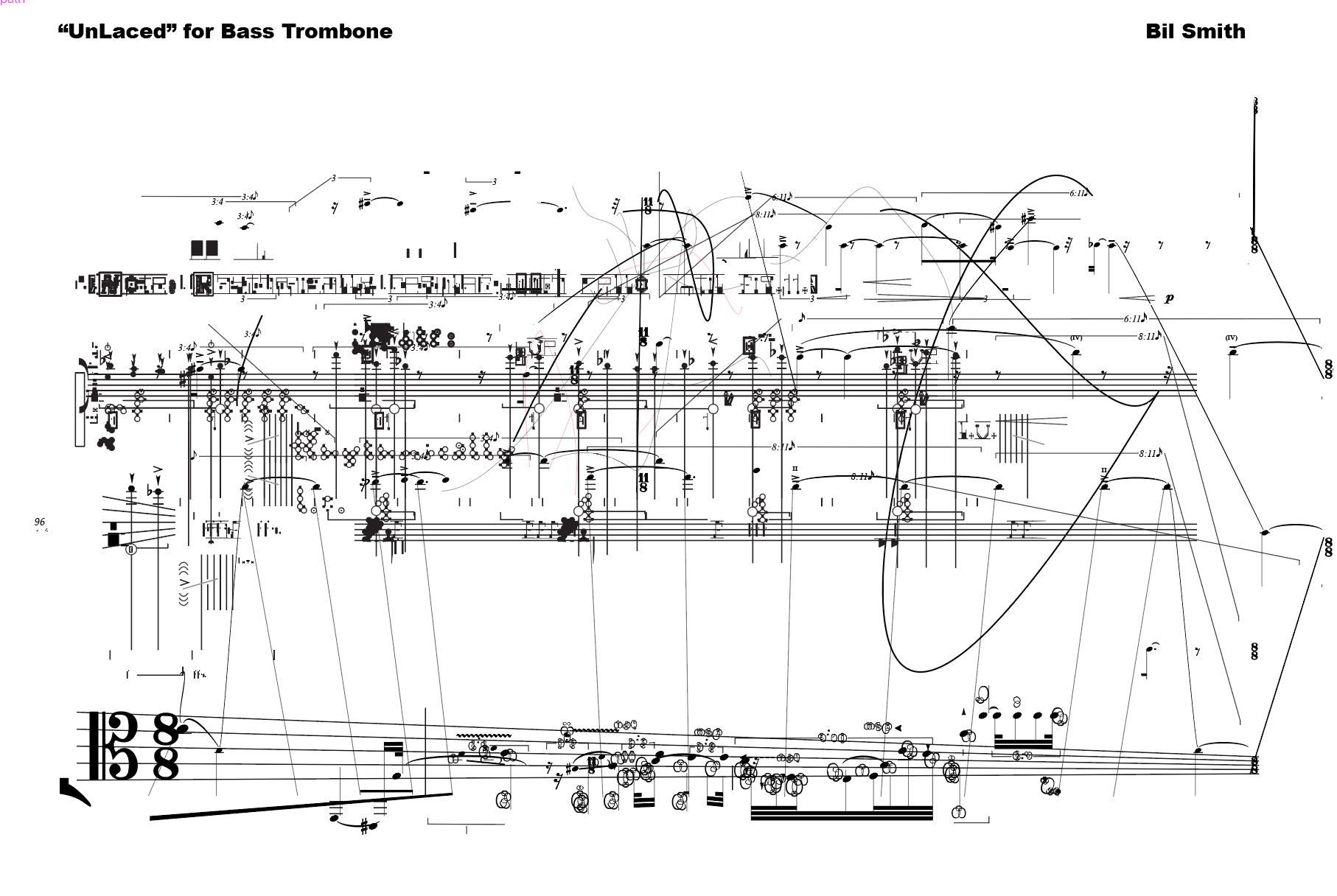
"UnLaced" for Bass Trombone


"UnLaced" 

for Bass Trombone

Bil Smith Composer

Link to Hi-Res PDF Score

https://drive.google.com/file/d/1wjxw4qm5NW6MI4A1a-IAeN9DZpPrZACw/view?usp=sharing

Symbolic Overidentification, Sublime Dissonance and the New Music Lexicon: Non-Traditional Notation


Symbolic Overidentification - a notation system that exaggerates and intensifies traditional musical symbols and structures, revealing the ideological underpinnings of our musical conventions.


Negative Dialectics of Notation - the critical reflection on the limitations and shortcomings of traditional music notation systems, with the aim of uncovering the implicit assumptions and ideological biases embedded in them.

Transcendental Signification - the process by which musical symbols acquire meaning through their relation to the subjectivity of the composer and the interpreter, as well as to the historical and cultural context of their production.

Disruptive Archetype - a fundamental musical structure that challenges the conventions and expectations of a given style or genre, by introducing new harmonic, melodic, or rhythmic elements.

Transcendental Synthesis - the unification of different musical elements, such as tonality, rhythm, and timbre, into a coherent and meaningful whole, through the creative intervention of the composer.

Sublime Dissonance - a type of musical dissonance that evokes a sense of awe and reverence, by transcending the limits of conventional tonality and revealing the hidden potentials of sound.

Aporetic Notation - a notation system that embraces the paradoxes and contradictions of musical expression, by allowing for multiple and conflicting interpretations of the same score.

Radical Temporality - the manipulation of time and duration in a musical piece, by introducing irregular or unpredictable rhythms, or by stretching or compressing the time intervals between notes.

Retroactive Causality - a musical composition that challenges our traditional understanding of causality and chronology in music, revealing the ways in which past musical forms can be reinterpreted and repurposed in the present.

"Unsent Compounds." for French Horn


"Unsent Compounds"

For French Horn

Bil Smith Composer


Link to Full Score PDF


The notation reads like a text laden with diminutive inscriptions, each element on the score not merely a directive for the musician but a signifier within a larger chain, contributing to a discourse that transcends traditional musical interpretation. The score invites the performer to confront the limitations of his perceptual apparatus: to engage with the score either up close, grappling with the minute details and risking the loss of the gestalt, or from a distance, capturing the whole yet missing the intricacies that give it substance.

This dichotomy; this oscillation between the immediate and the mediated reflects a fundamental tension, particularly in how we approach the unconscious. Just as the unconscious reveals itself only through slips and shadows, the score of "Unsent Compounds" reveals its full meaning not through direct observation but through the play of presence and absence, of sound and silence.

Architectural Analogies

The reference to architectural diagrams within the score is telling. The composer equates the structural elements of music to the foundational elements of a building. This analogy is not merely illustrative but deeply structural. Just as an architect might align a ground plan with an elevation, the score aligns the sonic with the symbolic, each note and rest mapped onto a conceptual framework that challenges the performer to navigate space musically and interpretatively.

The vertical runoffs and the gravitational pull they exert do not merely dictate the dynamics and phrasing but suggest a deeper, almost gravitational force at play, pulling the performer into the depths of the typophony of the notation. These elements do not freeze the gestures but, paradoxically, animate them with a dynamic tilt that propels the narrative forward.

Significantly, the score forecloses any sense of wild abandon. This is a crucial aspect as the foreclosure is a rejection of the fundamental signifiers leading to a return of the repressed in other forms—here, in the constrained yet expressive modalities of sound production. The musician, bound by the paratonal system, finds freedom not through ecstatic release but through a disciplined exploration of the boundaries set forth by the score.

The thick pools of architectural signs within the score, then, do not merely guide but demand a reconceptualization of musical performance as an act of constructing and deconstructing meaning, of finding order in apparent chaos, and of creating coherence in the face of structural fragmentation.


"Proproxasant; Indicated for Brugada Syndrome" for Piano


"Proproxasant; Indicated for Brugada Syndrome" 

for Piano

Bil Smith Composer

2024

Link to Hi-Res PDF