Sunday, June 14, 2026

"Idelytic" for Viola. Link to Hi-Res PDF Score


 "Idelytic"

For Viola

Bil Smith Composer

26" X 14"

Link to Hi-Res PDF Score

https://drive.google.com/file/d/1T02dBCf3zIYmomc7diYKuey3ZMUoT7PO/view?usp=sharing


Idelytic for Viola: A Personal Commentary

by Bil Smith


The title came before the piece. That is not unusual for me, but with Idelytic the word arrived with an insistence that felt less like naming and more like instruction. It is not a real word, which is precisely the point. It sits somewhere between idyllic and analytic, between the pastoral dream and the dissecting intelligence, and the tension between those two impulses is where the entire piece lives.

I want to be honest about where this came from.

There is a version of the viola that the repertoire has always known. Warm, recessed, slightly melancholy, the instrument that fills the middle of the harmonic picture without quite claiming the foreground. I have loved that voice my whole life. And I have also, for my whole life, felt that it was being slightly misrepresented. The viola does not live in the middle of things because it lacks the character to be elsewhere. It lives there because that is where everything is actually happening. The interior. The hinge. The place where the decision gets made before anyone announces it.

Idelytic begins from that interior position and refuses to stay there quietly.


The Visual Architecture

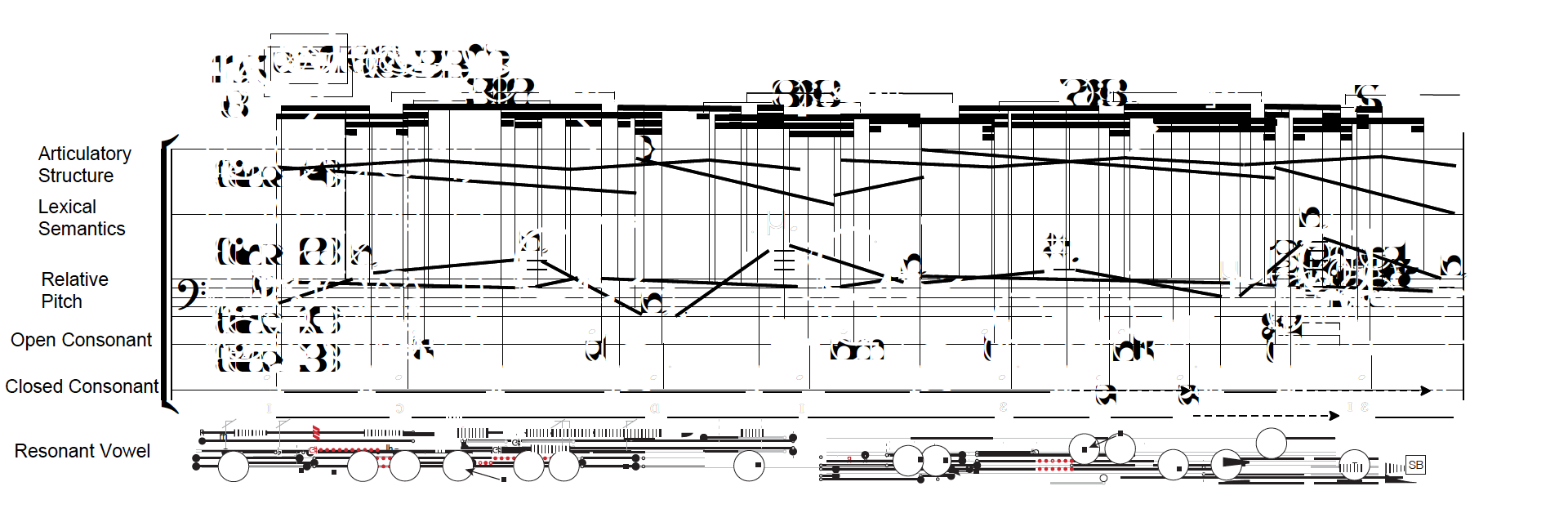
When you look at the score, the first thing that registers is density. The notation accumulates horizontally in a way that I have to confess looks, at first, almost aggressive toward the performer. Column after column of stacked material, overtone markings, multiple simultaneous voices, long sinuous slur lines that travel through the clusters like rivers cutting through rock. And at the center of the page, a kind of catastrophe: the lines converge, compress, fold into a knotted intersection where multiple trajectories meet at the same point simultaneously.

That convergence is not an accident and it is not a crisis. It is the structural heart of the piece.

What I was after was the moment in sustained thought when everything you have been tracking separately suddenly occupies the same space. Not resolution. Not synthesis. Just simultaneous presence. Every argument still active, every voice still moving, and for one moment they are all exactly here at the same time. The notation tries to capture that physically, on the page, as a visible event rather than a harmonic one.

After the convergence, the material continues. But it continues differently. The second half of the score opens out, the staves multiply, the column structures persist but breathe more. Something has passed through the eye of the needle and come out the other side still itself but changed by the passage.


The Idyllic and the Analytic

I grew up with music that trusted melody to carry everything. A long line, a shaped phrase, the sense that someone is telling you something and meaning every word. I still believe in that. I have never stopped believing in it. But I also grew up with the question of what happens when the melody becomes so loaded with intention that a single line can no longer hold it. When you need to hear several versions of the argument at the same time because none of them alone is sufficient.

The double and triple voicings throughout Idelytic come from that need. The viola is asked to sustain multiple simultaneous pitches, multiple simultaneous rhythmic threads, multiple simultaneous articulations. Not because I want to overwhelm the player but because I want the player to experience what it feels like to hold more than one true thing at once, which is something the viola's physical construction actually permits in ways other instruments do not.

The idyllic element is in the long curves that pass over the top of all that density. Those slur lines that begin somewhere in the first half and continue traveling through the convergence and out the other side, as if the melody simply did not notice the architecture beneath it and kept going regardless. That is the pastoral component. The dream persisting through the analysis. The song that does not stop because the mind has become complicated around it.


For the Performer

I have thought a great deal about what I am asking.

What I am not asking is for every notated element to be executed with equal precision and presence. The score is a field, not a sequence of instructions. The performer enters it and makes choices about what to foreground, what to let recede, where to press into the notation and where to let it pass beneath them. The convergence point in the center of the page is the one moment where I think the performer should feel the full weight of everything simultaneously. Before that, and after that, there is more room.

The tempo is not fixed because the piece is not about time in the metronomic sense. It is about duration. How long does it take to move through a complicated interior space? That is different for everyone and different every time. I am interested in that difference. I want the performance to carry the mark of the person giving it and the room they are giving it in, because the piece is ultimately about the experience of sustained attention, and sustained attention is always particular, always situated, always someone's.


What the Title Finally Means

Somewhere in the writing of this piece I understood that the word idelytic was describing not a place but a state. The state of being simultaneously inside an idyll and inside an analysis of that idyll. Of experiencing something beautiful and at the same moment being unable to stop examining how it works, why it affects you, what it is made of.


"Elastic Precision" for Four Violins. Bil Smith Composer


"Elastic Precision"

For Four Violins

Bil Smith Composer

2022

Published by LNM Editions

30" X 30"

"Corner and Crawl" for Solo Cello


"Corner and Crawl"

For Solo Cello

Bil Smith Composer

Published by LNM Editions

Link to Hi-Res PDF Score


New Tablature for Upcoming Work for Solo Voice (2023)


"Along With Photos of Notable Clients" for Bass Clarinet


"Plegaria" for Snare Drum and Spring Drum. Bil Smith Composer


"Plegaria"

For Snare Drum and Spring Drum

Bil Smith Composer

2022


"Povera" for Piano


"Povera" for Piano

Bil Smith Composer

2022

Published by LNM Editions

Link to PDF


W.I.P.>>>>> For Guitar....Continued


Polypruvit for Alto Clarinet: A Topography of Chambers, Auditoria, and Parliaments


"Polypruvit"

for Alto Clarinet

Bil Smith Composer


Published by LNM Editions

Link to PDF Score


Polypruvit for Alto Clarinet: Rooms That Listen Back

I have spent a long time thinking about where music actually happens. Not the concert hall, not the practice room, not the recording studio. The question is more fundamental than that. Where does it happen inside the score itself? What does the notation contain beyond its instructions?

Polypruvit arrived as an answer I wasn't expecting.

The score places the Alto Clarinet stave across a sequence of rooms. Not abstract space, not white silence between the lines, but actual rooms: parliaments, auditoria, debating chambers, council floors, legislative semicircles. Rendered in architectural plan-view, precise and cool as a surveyor's drawing, these spaces bisect the staff like they were always there, waiting for the line to pass through them.

The first time I looked at it, something shifted in how I understood what I was doing.

The clarinetist's line has always carried a kind of authority. It moves, it breathes, it argues. But here it becomes something more specific. It becomes the axis along which these chambers of human deliberation are organized. The staff is infrastructure. The rooms are built around it. Each page is not a new section of music so much as a new site, and the player is not reading forward through time but passing through space, one architectural proposition at a time. A full circle. A compressed vertical chamber. A double horseshoe. A spiral so dense it closes on itself. Each one a different geometry of how people arrange themselves when they have something important to decide.

I chose the Alto Clarinet because its voice lives in exactly the register of that kind of participation. Not the bright assertion of the soprano, not the grave pronouncement of the bass. The alto sits in the middle of things, in the room rather than above it, integrated into the body of whatever is happening rather than standing apart from it. It is the sound of someone who has the floor and knows how to use it without raising their voice.

The seating plans repeat across the sequence, and I want to be honest about what that repetition does to me. It is not decoration. It is closer to insistence, the way an argument returns not because it failed the first time but because the matter is still unresolved. These are the architectural archetypes of human deliberation, the physical forms we have built over centuries to give debate a shape, and each one carries its own rhetorical atmosphere. The compressed rectangular chamber feels different from the open amphitheater. The spiral feels different from both. The clarinetist moves through each of these not as a soloist traversing contrasting movements but as a voice adjusting to a changing room, reading the space, finding their angle.

What moves me most, returning to the pages again, is the final image: a small wedge of white lines on absolute black. After all those rooms, all that civic geometry, this. Something partial. Something almost lost. A fragment of seating still visible in the dark, like a chamber emptied out after a long session, chairs still oriented toward wherever the center was.

It struck me as the most honest image in the score. All that deliberation, and then this: the room after everyone has gone, still holding the shape of what happened inside it.

Polypruvit is a score about the spaces sound occupies before it becomes sound. It is a constitution for a performance that can never quite be legislated. And the Alto Clarinet, passing through each chamber in turn, is not a soloist and not a delegate and not an emissary. It is something simpler and stranger than any of those things.

It is a voice in a building that keeps changing around it, doing what voices have always done in rooms built for deliberation.

Making the argument. Listening to the room. Beginning again.


Saturday, June 13, 2026

Friday, June 12, 2026

The Score Functions as an Object and as a Protocol


ECHOES FROM THE ANTHROPOCENE


The score titled ECHOES FROM THE ANTHROPOCENE arrives as a field, not a text. You do not leaf through it for melodies. You stand before it and feel the pull of engineered bands, stacked horizontally in a dense chromatic geology. The square panel at the center repeats in variant palettes across the folios, each time encircled by an orbital ellipse that carries treble clefs, vectorized clusters, and instrument emblems. The eye tracks along the bands like a stylus moving across strata. The notation is not framed by staves so much as embedded in them, which turns reading into excavation.


This compositional posture calls up a precise art historical kinship. In 2011 Gerhard Richter subjected an older abstract painting to a regime of digital slicing, mirroring, and lateral extension. From thousands of vertical cuts he harvested the thinnest, end-stage strips, then laid them horizontally under Lucite. The result produced pressure on the retina. Color behaved like frequency. In my score the same conversion happens between image and sound. Digital procedure, once attached to pigment, is now attached to instruction. The bands do not decorate a system, they are the system, and the performer is asked to move across them as a needle passes across data.


Look closely at the first plate and you see a procession of glyphs that descend the square like instruments lowered into a shaft. The black noteheads do not align with any single staff; they puncture multiple bands at once, which collapses the old contract between sign and pitch. Accidentals sit like geological markers. A sharp becomes a pilon that pins one layer to another. A fermata resembles a centrifuge. When the eye reaches the periphery, small ornamental clusters appear. They feel like sensors or outposts that register the core’s activity. The ellipse that holds them is a rehearsal of orbit and feedback, a calm diagram of a planet that has turned its atmosphere into a recording surface.


The kinship with Richter is not a quotation. It is a shared ethic. Richter erased the painter’s hand by subjecting his own work to algorithmic violence. I erase the security of traditional notation by exposing it to the same industrial cut. In both cases the source remains, yet it is stretched until meaning becomes behavior. Early Richter cuts produced mirrored blots that still read as images. Late cuts produced bands that act like energy. Mine mirrors this arc across the sequence. One plate retains legible staff logic and suggests chamber polyphony. Another increases the density of bands and adds dotted verticals that read as time drilling through color. By the last plates the square is a bright field where signs hover and the ellipse itself threatens to become the score, not its frame.


I exploit this field with a practical ruthlessness. Cells are introduced, then split, then mirrored, then extended laterally until they function as durations rather than events. A black block lands like a slag deposit. Adjacent dots descend as if sifting through a grate. Arrows and anchors ask for pressure, not emphasis. There are passages where a single band, narrow and acidic, is asked to carry breath or bow noise while all other behavior is suppressed. The effect is not atmospheric. It is clinical. You feel what Richter made you feel when he sealed color behind glass. Sensation, then a layer of mediation, then the knowledge of your own looking or listening.

Material choices intensify the parallel. Richter’s strips sat under Lucite that reflected the gallery and folded spectators into the image. My folios are drawn for glossy stock, sometimes Mylar, so light rakes across the page and throws a second score onto the surface in the form of reflections. Performers must read through glare. The physical delay becomes an audible one. Gestures arrive with latency and the room begins to play back at the players. When the ellipse returns as a dotted perimeter, it begins to feel like a map of indirect sound paths. Richter’s 6 Standing Glass Panes had already taught viewers to accept reflection as content. I turn that lesson into method.

There is another link. Richter’s color charts from the 1960s used factory paint chips to strip subjectivity from selection. The digital strips updated that logic for the age of code. My bands work in the same historical current. Ready-made pitch and duration are no longer sufficient, since they tie the music to a literacy that hides its industrial context.  The page becomes an array of operations that can be executed by a trained ensemble, with or without the cushion of tonal memory. Execution is the painting. The performance is not an interpretation of content. It is the release of pressure along a designed path.

The title announces the field of discourse. ECHOES FROM THE ANTHROPOCENE does not illustrate weather or lament the glacier. It models systems that exceed intention. The orbiting ellipse reads as a governance diagram. Inputs travel along the circumference. Outputs strike the core, are recorded in the bands, then return as changes in density or hue. A white blur across one square is not atmosphere. It is the visual equivalent of compression, the crush that occurs when flows exceed capacity. A vertical seam that interrupts the spectrum is not a column. It is a fault line, and the notational objects that perch on either side of it behave like instruments trained to live with rupture.

My directive language deepens the analogy. Instructions are compact, almost pharmacological. Duration feels like dosage. Repetition functions as interval. The score speaks in protocols that treat the body and the room like a joint patient. Short exposures to high frequency. Long exposures to infrasonic pressure. Breaks calibrated for recovery. In rehearsal the ensemble becomes a clinic. The parts keep a log. The same passage is administered twice at different amplitudes in order to observe how the hall metabolizes stress. Musical phrase gives way to measured release.

What does this produce in listening terms. First, an awareness of scale. The bands read as horizons, yet the micro-signs embedded within them demand close work. The eye and ear must shuttle between far and near. Second, a transposition of cadence. Instead of symmetrical phrases you receive cycles of accumulation and discharge that belong to weather systems and supply chains. Third, a reframing of virtuosity. Craft is still there, but the heroism is in calibration. The most difficult task is to sustain a held behavior without telegraphing aim. Richter’s end-stage strips looked like smooth color, yet carried a history of cuts so fine they were no longer visible. My end-stage behaviors sound like sheen, yet carry a history of rules and refusals.

Exhibition should honor this. The score functions as an object and as a protocol. Show the plates at eye level in a continuous frieze, so the visitor experiences the strip effect before hearing sound. Stage public rehearsals, since the work’s ethic relies on transparency. Present take sheets that document timings, failures, and recovered solutions. Install acoustic baffles in the shape of the outer ellipse, then let the ensemble play through them. You will hear the echo pattern that gave the piece its title.

I have translated a decisive lesson from late painting into a new language of musical inscription. Richter demonstrated that digital process can operate as a historical instrument, not as a fashionable trick. I take that stance and applies it to notation. The bands, the cuts, the mirrors, and the lateral pulls are not quotations. They are structural tools for composing in a century defined by replication, extraction, and feedback. The result is a score that thinks like infrastructure and sounds like pressure made audible.

You leave the room with a recalibrated ear. Horizontal color has become time. Glyphs have become valves. Reflection has become a voice. The echo is not a metaphor. It is the world answering back.

"Phas Iria Aven" For Trombone. Bil Smith Composer

"Phas Iria Aven"

For Trombone

Bil Smith Composer

2023

Commissioned by Ericsson

Published by LNM Editions

Link to PDF (Hi-Res)


Thursday, June 11, 2026

W.I.P.>>>>>>> For Guitar


There is a row of pin-up girls at the top of this score.

Each one holds a block of cheese. Each one is accompanied by a sloth.

This is not decoration. This is the piece telling you exactly what kind of attention it requires before you have read a single note.

The notation below is some of the most demanding material I have written for guitar. Four simultaneous staves operating at different logical levels. Time signatures of 08 over 17 and 4000 over 008, which are not errors and not provocations but precise specifications of a temporal experience that conventional meter cannot contain. Tuplet groupings of 3, 4, 5, 6, and 8 in simultaneous deployment across independent voices. Extended techniques rendered in a notational language that borrows from multiple traditions and resolves into none of them. A second clef entry mid-page at 085 over 178, the tempo itself a fraction, the music inside it a further subdivision of something already impossibly subdivided.

And above all of this: women, cheese, and sloths.

The juxtaposition is not ironic. It is not surrealist in the fashionable sense of random image collision. It is a genuine compositional proposition about the relationship between maximum notational complexity and maximum notational absurdity, the idea that the most serious musical demands and the most cheerfully ridiculous imagery belong on the same page because they are both, in the end, asking the same thing of the person who encounters them.

Which is: stay with this. It will not explain itself. But it will reward you.

The sloth knows. The sloth always knows.

Wednesday, June 10, 2026

Intuitive Compositional Tablatures: The Circos Development Tool

"Dendon" for Solo Tuba (2018)


"I Think I Am Rich" for Tuba and James Trussart Steel Deville Electric Guitar


"Temperance Meant Swimming Through The Heat" For Accordion and Schilke 'G' Trumpet

"Vague Emotional Overflow" for Trombone and Flute


"Craterfaced Woman Sell Sugarcane Juice In Plastic Bags" for Three Sopranos

"Extremity, Such As It Is, Half-Mercifully Attenuates Itself By Being Quotidian"
For Oboe and English Horn


Partial element (utilizing Circos) from one of the pages of the score for "Partitions: Cambics Alive in Sensient Amplules" for Chamber Septet.  World Premiere, April, 2014 with Renee Baker and The Chicago Modern Orchestra