The Pharmacological Imaginary: Reframing Notation
If the notational process, as outlined in The Hypothetical Pharmacopeia, reveals a complex interplay of composer intention and performer agency, then its successor, The Pharmacological Imaginaryproposes a step further: a speculative architecture of musical meaning. Drawing influence from my brand name endeavors, the fractured geometries of architects Lebbeus Woods and Thom Mayne, the typographic disruptions of David Carson, and the conceptual provocations of Barbara Kruger and Ed Ruscha, this reimagining turns notation into a hyper-textual construct where layers of meaning collide and refract.
Notation as Speculative Blueprint
Lebbeus Woods once said that architecture could be an "instrument of transformation rather than stability." In this vein, The Pharmacological Imaginary treats notation not as a stable grammar but as a speculative blueprint—a framework for sonic potentialities that exists in a perpetual state of becoming. Each notational gesture, whether linguistic, graphic, or spatial, functions less as a directive and more as an architectural fragment, evoking the incomplete yet evocative structures of Woods’ dystopian visions.
Consider the term Oscilith, embedded within a score as both linguistic artifact and graphic node. Its phonetics suggest oscillation, a wavering instability, while its visual placement might resemble a fragmentary beam intersecting with chaotic vectors of traditional notation. Here, the score becomes a fragmented architecture. It is a labyrinth where performers must navigate disjunctures between sound, language, and space.
The Typographic Terrain: Disruption as Aesthetic
Borrowing from David Carson’s chaotic typographic landscapes, The Pharmacological Imaginary rejects the clarity of conventional notation in favor of a disrupted textuality. Each neologism within the system, constructed with the precision of a pharmaceutical naming architect like Bill Smith, functions as both a sonic catalyst and a visual rupture. The terms are deliberately illegible in the conventional sense, demanding a performative interpretation that oscillates between reading, seeing, and hearing.
Take the example of Velocryptin. Its jagged phonetics conjure notions of speed and concealment, yet its typographic representation might appear fractured, with overlapping glyphs creating the impression of a sonic velocity tearing through the notational fabric. This visual disruption transforms the score into a dynamic field where linguistic artifacts resist fixed interpretation, much like Carson’s deconstructed typographies challenge the reader’s expectations.
Neological Precision: Reflections on Naming and Notation
In both pharmaceutical branding and the wider terrain of semiotic invention, I’ve always believed that names must do more than identify as they must function, evoke, and endure. Over the years, I’ve had the privilege of naming brands that now live inside millions of conversations and prescriptions daily. Veozah, Exondys, ACUVUE, Abilify, Viagra, Remicade, Lantus, Evenity. These are not just trademarks; they are linguistic instruments, engineered with a high degree of precision across phonetics, semantics, and regulatory acceptability.
But the deeper challenge, and the greater reward, lies in creating names that operate at the edge of function and fiction. That’s where I see an overlap between pharmaceutical naming and notation systems within post-conceptual music, performance, and speculative linguistics. Both ask the same core question: How can a fragment of language hold and transmit layered meaning under constrained conditions?
Take the term Chronovance. While not a pharmaceutical brand, it reflects the same principles I apply to high-stakes naming. “Chrono” encodes time, temporal scaffolding, duration, and sequencing. “Vance” suggests forward movement, an imagined velocity, an ascent. Together, they form a structure that’s both evocative and instructive. It’s a name that gestures toward progression, modulation, and perhaps even transformation. In a performative or compositional lexicon, it becomes more than a term...it becomes a provocation.
This is what I call neological precision: the intentional compression of narrative, rhythm, and utility into a single, resonant unit of language.
My methodology, whether applied to therapeutics or theoretical systems, is grounded in three things:
-
Phonosemantic resonance: Names must sound like what they meanor disrupt what is expected.
-
Functional clarity: The name must carry its own weight without needing footnotes.
-
Narrative implication: The name should offer the possibility of a story, even if the story is never told.
This aligns naturally with the goals of The Pharmacological Imaginary and other post-notational frameworks that seek to build lexicons with purpose and poetry. Each term is a capsule of potential, designed to be activated by interpretation. Much like a drug acts differently in every body, a name, if well designed, permits variation while preserving intent.
In this way, naming becomes a form of composition. And composition, like branding, becomes a search for resonant minimums as the smallest unit of language that can do the most work.
Let that be the work of neology: a practice of generative constraint, semantic innovation, and conceptual elegance.
-1967%20(1).jpg) |
| Agostino Bonalumi |
Notational Reliefs: The Influence of Bonalumi
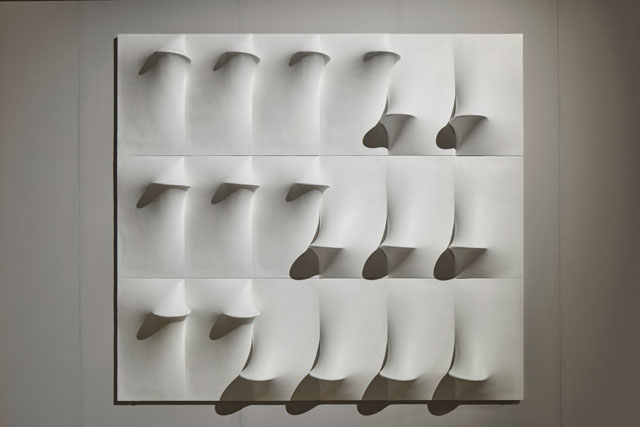
Incorporating the aesthetic of Agostino Bonalumi’s three-dimensional reliefs, The Pharmacological Imaginary treats the score as a sculptural object. Notation becomes a hyper-surface where linguistic elements protrude and recede, creating layers of interpretative depth.
For instance, a term like Spectratine might be inscribed within a raised segment of the page, its physical elevation suggesting a sonic emphasis or spatial projection. These sculptural notations disrupt the two-dimensionality of traditional scores, compelling performers to engage with the score as both visual and tactile artifact.
 |
| Barbara Kruger |
Semiotic Collisions: The Kruger Effect
Barbara Kruger’s conceptual practice, with its bold textual interventions and interrogations of power, informs the Pharmacopeia’s capacity for semiotic collision. Each term within the systemacts as a conceptual trigger, inviting performers to navigate the tensions between linguistic signification and sonic realization.
Kruger’s directness finds resonance in the Pharmacopeia’s ethical stance: it demands that performers confront the multiplicity of meaning embedded within the score, rejecting reductive interpretations. This confrontation parallels the dynamic interplay of language and authority in Kruger’s work, positioning the score as a site of dialogic tension.
The Temporal Landscape: Beuysian Flux
Joseph Beuys’ ethos of transformation and fluidity informs the Pharmacopeia’s temporal dimension. Terms like Temporis or Chronotrope function as chronotopic markers, disrupting linear time and introducing flux into the score’s unfolding. These markers operate as temporal catalysts, compelling performers to inhabit moments of suspension, acceleration, or recursion.
Beuys’ concept of the social sculpture finds its analog here: the performer becomes an active participant in shaping the temporal architecture of the piece, transforming the score from static object to living process.
The Ruscha Layer: Language as Image
Ed Ruscha’s playful yet incisive engagement with text informs the Pharmacopeia’s treatment of language as both semantic and aesthetic material. A term like Lumivox, for instance, might be rendered in bold, luminescent typography, its visual presence amplifying its sonic implications.
Ruscha’s work underscores the Pharmacopeia’s central proposition: that language within the score is not merely read but experienced. Each term becomes a locus of aesthetic and performative potential, bridging the gap between linguistic abstraction and sonic realization.
Conclusion: Toward an Open Notational Ecology
The Pharmacological Imaginary repositions musical notation as a speculative architecture, one that draws from the disruptive geometries of Woods and Mayne, the typographic experiments of Carson, the neological precision of Bill Smith, and the conceptual provocations of Kruger, Beuys, and Ruscha. It is a system that resists stability, embracing instead the productive disjunctions between composer, performer, and score.
In this ecology, notation becomes a living process. It is a hyper-surface of meaning where language, sound, and image collide and refract. The Pharmacological Imaginary challenges us to think beyond the fixed hierarchies of traditional scores, inviting us into a labyrinth of interpretative possibility. It is not merely a notation system but a speculative act, a reimagining of the score as a space of infinite potential.


.jpg)
-1967%20(1).jpg)


