Wednesday, February 11, 2026

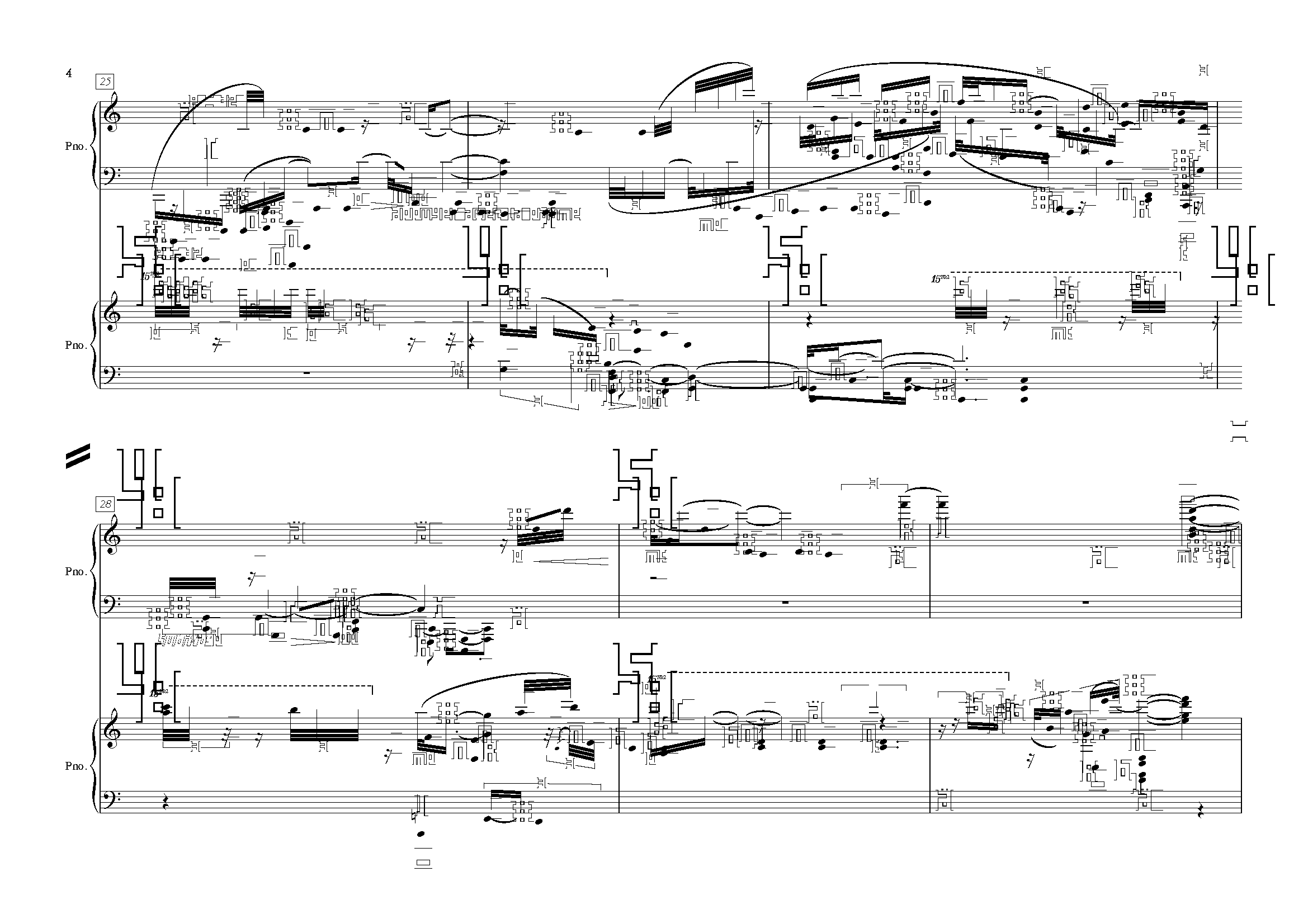
"Artifice and Pretense" for Solo Piano


"Artifice and Pretense" 

for Solo Piano

Bil Smith Composer

2024

Link To Large Format PDF Score


"Artifice and Pretense," is a piece crafted with a paratonal notation system. Much like a message from a distant world, encoded in symbols that flirt with the edge of comprehension, the pianist, faced with the diminutive inscriptions of the score, finds themselves at the threshold of an insurmountable task. To engage with each note is to attempt to decipher a language without a key, where each symbol, each gesture, holds the promise of revelation and the threat of further obfuscation. This meticulous scrutiny, while revealing the microcosm of complexity within each notational element, simultaneously obscures the grandeur of the composition as a whole. It is a paradoxical pursuit, emblematic of the human condition: the more one seeks to understand, the more elusive understanding becomes.


Alternatively, for the Pianist to absorb the piece in its entirety from a distance is to grapple with the inverse dilemma. One might capture the essence, the overarching structure, but in doing so, the individual nuances, the intricate details that give the piece its soul, evaporate.  This detachment, a necessary sacrifice for the sake of comprehension, mirrors the alienation of the individual from the intricacies of existence, where the whole can never truly be grasped without losing sight of the parts that constitute it.


The introduction of a new progeny of musical expression, through the banishment of quasi-atmospheric modulations and the embrace of vertical runoffs, represents a rebellion against the constraints of tradition. Yet, this rebellion is not without its own contradictions. The gravitational pull of these runoffs, designed to liberate the gestures of the notation, instead imposes a new form of confinement. The score, with its thick pools of architectural diagrams, suggests an order, a system of coordinates that promises orientation within the chaotic sprawl of the music. But this system serves only to ensnare further, to heighten the sense of disorientation.


The performer, standing alone before the piano, becomes a figure of tragic heroism, engaged in a Sisyphean task where the act of performance is both an assertion of agency and an admission of its futility.


The Dense Labyrinth of Bil Smith’s Compaction Music


The Dense Labyrinth of Bil Smith’s Compaction Music

By Rick Geller

In the domain of speculative compositional practice, Bil Smith's Compaction Music emerges as an intricate labyrinth, a site where reductionism is transfigured into a game of multiplicities, obfuscations, and dense interrelations. It is a form of compositional philosophy that recasts sonic material as the locus of theoretical economy, ontological condensation, and methodological rigor. By invoking reductionist thought, not as a limiting force, but as a field for generative complexity, Smith invites us to consider how compaction itself becomes a performative and intellectual strategy for the destabilization of musical assumptions.

Reduction in the philosophical sense often involves the mapping of one domain onto another, simpler framework, physical properties onto atomic structure, chemical interactions onto quantum mechanics, or cognitive processes onto neural patterns. Smith adapts this epistemological maneuver, translating it into musical practice, where the dismantling of structure does not merely clarify but mystifies, folding the act of understanding into the impossibility of total comprehension.

Compactionism as Epistemic Framework

Smith’s methodology can be categorized into three core axes... methodological, theoretical, and ontological compactionism.  Each of which operates with overlapping purposes but distinct phenomenological implications. The reductionist orientation of Compaction Music is not a simplifying act but a contracting one, collapsing the spacious into the dense, the audible into the tacit, and the perceivable into the obscure.

Methodological Compaction:

At the methodological level, Compaction Music operates like a musical collider, breaking down expansive compositional gestures into their smallest perceptual units. A singular tremor of the tuba, for example, might be dissected into its overtonal constituents, its micro-temporal instability, and its implied silences. These smallest sonic "particles" become nodes of hyperactivity, where the sonic material behaves paradoxically: as both minimalistic and overabundant, sparse yet overwhelmingly dense in interpretative potential. The process mirrors the reductionist impulse in science, where boiling points are traced to atomic dynamics, and atomic dynamics to quark interactions except that here, the breakdown does not aim at a clearer truth but a proliferating ambiguity.

In works like Ewart Bandina, Smith maps microstructural fragments into recursive layers of interpretation. The score itself serves as a performative text, wherein symbolic representations are not guides but provocations, forcing the performer to reconstitute broken fragments into their own internal logic. The act of "reading" the score becomes inseparable from the act of "creating" the music.

Theoretical Compaction:

The theoretical dimension of Smith’s practice aligns closely with the reductive aspirations of unification found in scientific paradigms. The idea of a theory of everything in physics (a singular explanatory framework encompassing disparate phenomena) finds a curious analogue in Compaction Music. Here, disparate sonic events, notational systems, and even interpretative biases are folded into overlapping compositional matrices.

In Scant, a work utilizing a cylindrical coordinate system, radial symmetry is repurposed to collapse multiple timelines into a single representational form. Time becomes a circular economy of interaction rather than a linear narrative. This circularity, while seemingly restrictive, allows for an infinite set of radial relationships, each vector radiating outward to imply gestures unbound by hierarchical structure. In doing so, Smith challenges traditional linearity in musical form, offering instead a theoretical compactness that generates endless interpretative multiplicities.

Ontological Compaction:

Ontologically, Compaction Music does not propose an escape from complexity but situates complexity within a monistic reduction of essence. To reduce, in this sense, is to reveal an essence so densely compacted that it no longer presents itself as singular or reducible. Sonic particles in Smith’s framework are not isolated entities but networks of entangled relationalities, where one event necessarily implicates another. A gesture played in the tuba’s lower register, for example, may resonate with spectral instability, its overtone series bleeding into silence, implying textures that remain physically absent yet conceptually essential.

This ontological condensation aligns with Smith’s fascination with materiality and ephemerality. The act of reduction is not only compositional but existential, asking whether all musical events can, in fact, be reduced to their barest form, but whether reduction itself creates a new layer of obfuscation.

Compaction Music as Game and Praxis

Smith’s approach to composition does not merely represent compaction; it performs it through gamification. Much like the Oulipian experiments of constrained writing, Compaction Music imposes arbitrary limits on its material, forcing creativity to emerge from the confines of rule-based systems. Yet Smith’s rules are not simply constraints; they are provocations. They destabilize traditional notions of form, materiality, and interpretation, leaving both the performer and audience to grapple with the unfolding of indeterminate logics.

In works influenced by Arte Povera, Smith juxtaposes the monumental and the disposable. A decaying multiphonic might coexist with a pristine harmonic sequence, both occupying the same sonic space yet conflicting in their material realities. This tension creates a gamified experience for performers, who must navigate between instruction and improvisation, between the hyper-specificity of the score and the emergent logic of the moment.

Aural Structure as Sonic Topology

One of Smith’s most provocative contributions is his reconceptualization of musical structure as aural topology. In this framework, musical properties are no longer conceived as fixed, discrete units but as elastic surfaces subject to stretching, folding, and compaction. A score in Compaction Music is a map not of notes but of tensions, deformations, and resonances. Each gesture, rather than standing alone, is a topological feature embedded in a larger sonic terrain.

In Ewart Bandina, for instance, performers navigate a landscape where every decision affects the perceived curvature of the whole. A single staccato articulation might “compress” a subsequent phrase, altering its interpretative density. This interactive process mirrors philosophical reductionism in its focus on relationality but amplifies the generative potential of reduction by refusing closure.

Conclusion: The Infinite within the Compact

Bil Smith’s Compaction Music is not merely a compositional technique; it is a philosophical stance, a reflection on the paradoxes of reductionism itself. By collapsing expansive ideas into dense nodes of interpretative potential, Smith challenges the very notion of clarity, suggesting that reduction is not the absence of complexity but its intensification.

In the world of Compaction Music, a single sonic particle can carry infinite implications, and a reductionist score can open vast interpretative landscapes. Smith invites us to consider the spaces between the compacted and the infinite, between what is written and what is implied, and between what is heard and what is imagined. Compaction Music is, ultimately, an invitation to inhabit the dense, labyrinthine folds of sonic thought.  It is an  infinite world compacted into every note, every gesture, and every silence.

"Topped Out" for Guitar, Accordion, Viola and Violin

"Topped Out" 

for Guitar, Accordion, Viola and Violin

Bil Smith Composer

"Topped Out" for Guitar, Accordion, Viola, and Violin was created as a testament to the innovative use of combinatorial scores. This piece integrates traditional notational elements with a contrastive lexical system.


The foundational premise of this combinatorial score is its employment of a lexical system that operates in an essentially relational manner. Unlike traditional scores, where notation might serve as a direct instruction for performance, the lexical units in "Topped Out" are defined primarily by their interconnected relationships. These relationships are both paradigmatic, concerning the selection of alternatives based on similarity or dissimilarity, and syntagmatic, pertaining to the combination of units in linear sequences. It is through these networks of relationships that the piece articulates the performers' musical and expressive content.


Drawing from the principles of Meaning-Text theory, the score's lexical system can be likened to a graph or a "social network of lexical units," akin to the structures observed within small world networks. This analogy highlights the non-hierarchical, interconnected nature of the system. Each lexical unit coupled with notational devices, gains significance not in isolation but through its connections to other units within the network. This model is radically distinct from taxonomic approaches to lexicon organization, which traditionally classify lexical units into hierarchical structures.


Performers are required to navigate a score that functions more as a map of relationships and possibilities than a set of prescriptive instructions.


"The Contrast Was Noticeable" 
For Baritone Sarrusophone in E Flat

Baritone Sarrusophone in E Flat


Tuesday, February 10, 2026

"Modernismo". For Flute & Piano

"Modernismo"

For Flute & Piano

2015-2016

Bil Smith Composer

A Commission From DHL

Published by LNM Editions, 2017

(Laboratorie New Music)

A creative artistic movement that took shape in the 1880s in Spanish America, Modernismo has traditionally been identified with efforts to reinvigorate innovative literature and music through the pursuit of formal perfection and innovation. It was, however, more than an aesthetic undertaking. Modernismo offered a complex response to the profound social and cultural shifts that accompanied the arrival of modernity in Spanish America. 

Its influence extended to both sides of the Atlantic, largely because of the artistic genius of the peripatetic Nicaraguan poet Rubén Darío (1867– 1916), who selected its name and, by example and decree, came to define the movement. He established connections with the most celebrated European and American composers and writers of the day and, by 1896, as the sole survivor of the movement’s founding members, became its creative center of gravity. 

While the influence of Modernismo lasted well into the 20th Century, its closing date is generally held to coincide with Darío’s death in 1916.


"Jaywalk" For Oboe


"Find A Pretext For Skylarking" for Tuba


 "Find A Pretext For Skylarking" 

for Tuba

Bil Smith Composer

Published by LNM Editions

Link To Full Score (PDF)


"Reboard The Fiendish Conveyance". For Ensemble. The Full Score PDF Link


"Reboard The Fiendish Conveyance"

For Ensemble.

Bil Smith Composer

Published on LNM Editions

(Laboratorie New Music)

PDF Link To Score:


"A Faraway Curtain Of Purged Hide Whose Edges Let In Blue Light" for Bass Trumpet and Flute


"A Faraway Curtain Of Purged Hide Whose Edges Let In Blue Light" 

for Bass Trumpet and Flute

Bil Smith Composer

Link To PDF of Full Score (15 pages)


Published By LNM Editions


At the heart of this composition lies a planimetric system of notation, a dense patterned topographical system, which organizes motifs in a manner that is inherently continuous yet segmented categorically. The continuous nature of these motifs presents a controlled fluidity while their categorical segmentation imposes a structure that demands meticulous attention to detail from the performers.


The score further defines itself through the use of a dissimilar combination of spatial references, which serve to produce displacements within the musical narrative. These displacements are not random but are carefully calculated to yield the perspective information necessary for performance calibration. By manipulating spatial references, I created a sonic landscape that is constantly shifting, compelling the performers to adapt their interpretive strategies in real-time. This dynamic interplay between spatiality and sound adds an additional layer of complexity to the piece, challenging performers to recalibrate their approaches continuously.


The performers must embrace the recognition of the mutability of substances as a driving force behind the score's structure. This mutability is not merely a metaphorical concept but a tangible element that influences both the creation and execution of the piece. Just as substances change state in response to external conditions, so too does the musical material of this composition respond to the interpretive decisions of the performers. The initial composition, while providing a framework for the piece, is only one component of its ultimate realization. The true essence of the work emerges in the interplay between the written score and the performers' interpretation, a dynamic process that gives life to the music in real-time.